Galaxy · Dorado
LMC Large Magellanic Cloud
mag 0.49.2° across
About
LMC, the Large Magellanic Cloud, is a galaxy of magnitude 0.4 in Dorado, about 9.2° across.
How to find it
- LMC is in the constellation Dorado.
- Best evenings: around late January it is highest at about 9 pm (10 pm in summer time); a month earlier, two hours later.
- Where on Earth: it is seen well, at least 10° up, from south of 10° N.
When it rises and sets tonight, how high it climbs and how much the Moon gets in the way are worked out in your browser for your place.
What you will see
- EyesAn obvious misty patch from the southern hemisphere, like a piece broken off the Milky Way.
- Binoculars (10×50)Full of knots — star clusters and nebulae, including the Tarantula.
- Telescope (6–8 inch)Hundreds of clusters and nebulae to explore, one field at a time.
For a dark country sky with no Moon. From a city, faint galaxies and nebulae can disappear completely.
Facts
| Designations | LMC |
|---|---|
| Type | Galaxy |
| Magnitude | 0.4The smaller the number, the brighter. |
| Apparent size | 9.2°the full Moon is 31′ across |
| Surface brightness | ≈ 22.7 mag/arcsec²Estimate from the magnitude and size, per square arcsecond. |
| Constellation | Dorado |
| Right ascension (J2000) | 05h 23m 34.5s |
| Declination (J2000) | −69° 45′ 22″ |
More in Dorado
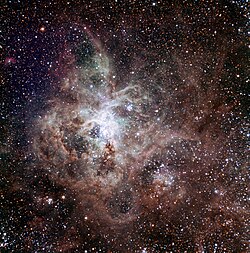 NGC 2070Tarantula NebulaEmission nebula · mag 5.0
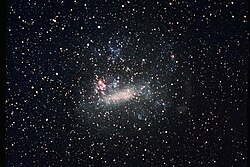 ESO 56-115Large Magellanic CloudGalaxy · mag 0.3
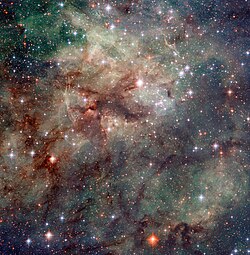 NGC 206030 Dor BSupernova remnant · mag 9.6
 NGC 1910S Dor ClusterCluster with nebula · mag 9.7
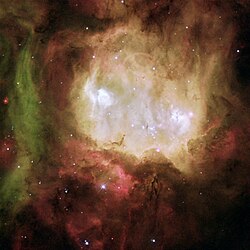 NGC 2080Ghost Head NebulaEmission nebula · mag 10.4
 NGC 1922Starfish ClusterOpen cluster · mag 11.5
Sources and credits
Catalog data: OpenNGC by Mattia Verga, CC BY-SA 4.0, and d3-celestial by Olaf Frohn, BSD 3-Clause. All data sources →